Be The Healthy U!
  • Healthy Blog
  • Healthy Recipes
  • Online Cooking Classes
  • I Can Help
  • 28-Day Program
  • Healthy Dog Blog
  • About Terri
  • Resources
  • Ask Dr. Terri
  • Testimonials

The Myth about Dairy and Calcium

9/29/2016

0 Comments

 
Picture
​Let’s talk about dairy and calcium. We have been brainwashed to believe that we must consume dairy to be healthy and that dairy is the only dietary source of calcium. We’ve also been told that if we don’t consume milk or other dairy foods, we can’t possibly get enough calcium. But is that really true or is it just a myth that we need dairy in order to be healthy and get enough calcium? Let’s find out.
 
We’ll start with an interesting story that Dr. Neal Barnard shares in his book “21-Day Weight Loss Quickstart” about a man who was raised in Asia and came to the U.S. to go to college. He began having gas, bloating, cramps, and diarrhea. His doctor thought he had a parasite, but found nothing after a series of tests. Meanwhile, the symptoms continued. After seeing various specialists, there was still no explanation for the man’s problems and his symptoms continued. He was miserable!
 
After struggling for two years with his intestinal problems, a new doctor asked the man a few simple questions about his diet. Did he drink milk back home? No. Milk was not part of his culture other than breast-feeding. Has he been drinking milk since coming to the U.S.? Yes.
 
The doctor suggested he stop drinking milk, and within two days, his symptoms completely disappeared!
 
It’s not natural for us to drink milk other than our own mother’s breast milk during infancy. We are the only species that drinks milk after being weaned and we are the only species in nature that drinks milk from another animal.
 
Lactase is an enzyme that our bodies produce to digest the milk sugar lactose. Our bodies normally stop producing lactase after we’re weaned because in nature, we no longer require lactase past weaning. Once our bodies stop producing lactase, dairy consumption is likely to cause gas and pain. In other words, we develop lactose intolerance.
 
By continuously drinking milk and/or consuming other dairy foods after being weaned, we trick our bodies into continuing to produce lactase well past the time that it normally would have stopped. Some people produce lactase well into adulthood and tend not to have intestinal discomfort from drinking milk or consuming dairy.
 
However, most people develop lactose intolerance sooner or later. That’s because we were not designed by nature to drink milk or consume other dairy foods past infancy.
 
Milk is the perfect food…for a calf. Milk is loaded with growth hormones (IGF1) that are designed to rapidly grow a calf to ~1,000 lbs. So what do you think milk does for our bodies? It “beefs us up”. In other words, it makes us fat. Plus, it loads our bodies with growth hormones, something tumors love because growth hormones help tumors grow quickly!
 
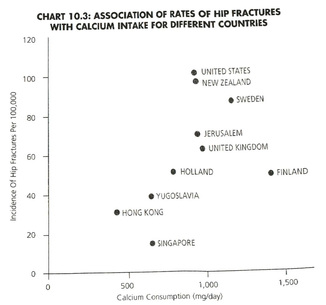
Here’s something else to consider: we’ve all been told over and over to drink milk to get our calcium so that we can develop and keep our bones strong and healthy. Here in the U.S. we are among the top in the world in terms of dairy consumption, and according to that logic, we should also be among the top in the world in terms of strong, healthy bones.
Picture
From "The China Study", T. Colin Campbell, PhD & Thomas M. Campbell II, MD, p. 209

Picture
​Yet we’re not. Instead, we are among the top in the world with hip fractures, a sign of osteoporosis. We are not alone, because so are all the other countries that sit alongside us with high dairy consumption.
 
That’s in part because our bodies don’t absorb as much calcium from milk and other dairy foods as we do from plant-based foods. Animals, including cows, do not produce calcium. Cows get their calcium from eating grass. And if cows are not eating grass, as most are not these days, then they get their calcium from supplements, typically made from limestone (a rock) and shells (same as the supplements sold in stores). Calcium from these sources is less absorbable and less bioavailable compared to calcium from plants such as grasses, greens, and beans. Plants get calcium by absorbing it from the soil they’re grown in, making the calcium in plants more readily absorbable by our bodies.
Picture
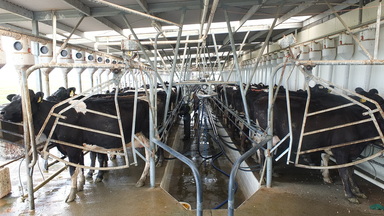
Dairy cows.
And in part because milk and other dairy (and other animal-based foods as well) cause our bodies to lose calcium. Animal-based foods lower the pH of our blood, making it more acidic. Our bodies have a natural pH buffering system for our blood, and that’s the calcium and phosphate that’s in our bones! Our bodies leach material from our bones, including calcium, to keep our blood pH in the proper range of 7.35 – 7.45. Once our blood pH is corrected, the calcium that was leached from our bones does not go back into our bones. Instead, it gets eliminated in our urine (we pee it out).

It’s the dairy industry that’s been telling us for generations that we have to get our calcium from milk. They just happen to ignore two little details that they don’t want us to know about, including that milk is not the only source of calcium, and that drinking cow’s milk is indeed not natural for humans.
 
So if dairy is not the best source of calcium, then what is the best source? It turns out that plant-based foods are loaded with calcium, especially leafy greens and beans. There are several great plant-based sources of calcium, including tofu; edamame (fresh soy beans); leafy green vegetables such as kale, spinach, collard greens, chard, mustard greens, and turnip greens; beans such as black-eyed peas, chickpeas, black beans, and pinto beans; and nuts such as almonds, walnuts, pecans, macadamia nuts, and cashews.
 
Many whole, plant-based foods provide us with more calcium per 100 calories than milk and are the healthiest sources of calcium. For example, 100 calories of whole milk (2/3 cup) has 188 mg of calcium. Compare that to the calcium levels in 100 calories of some leafy greens: a cup and a half of spinach, which would make a very nice spinach salad, has 216 mg, and likewise, a cup and a half of kale has 271 mg.  Even a whole orange has approximately 60 mg of calcium!
 
Beans are also great plant-based sources of calcium. One cup of boiled beans such as regular white beans has 161 mg of calcium, small white beans has 131 mg of calcium, navy beans has 126 mg of calcium, great northern beans has 120 mg of calcium, yellow beans has 110 mg of calcium, regular black beans has 239 mg of calcium, and small black beans has 102 mg of calcium.
 
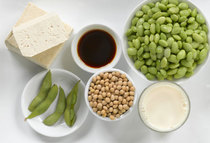
In particular, soybeans and soy products are especially good sources of calcium, including boiled soybeans (175 mg calcium/cup), roasted soybeans (237 mg calcium/cup), tempeh (184 mg calcium/cup), calcium-enriched soymilk (299 mg calcium/cup), tofu yogurt (309 mg calcium/cup), and frozen, prepared edamame (98 mg calcium/cup). Raw regular and firm tofu prepared with calcium sulfate top the list with 434 and 861 mg of calcium per half cup respectively!
 
There are many great ways to enjoy beans and greens together. Try a black bean burger with tomato slices and a few kale leaves, or a tofu scramble with wilted spinach. How about an arugula salad with chickpeas and quinoa or a bean burrito with brown rice and Swiss chard. One of my favorites is a warm whole grain tortilla topped with about a quarter cup of hummus, a large handful of arugula, kale, or spinach, and a sprinkle of rice vinegar, then folded in half like a taco.

Back to the question: is it just a myth that we need dairy in order to be healthy and get enough calcium? It turns out that it is a myth. Not only can we get all the calcium we need from whole plant-based foods, those same plant-based foods promote good health and protect us from chronic degenerative diseases.
0 Comments

Do Mangoes Have Manganese?

9/21/2016

0 Comments

 
Picture
Did you know that manganese is a metallic chemical element that is an essential trace nutrient? Dietary manganese, commonly referred to as a trace mineral, plays a large role in optimizing our health, and here’s why:
  • Our bodies need manganese for healthy bones and normal bone growth. Manganese contributes to bone density, which may help prevent bone fractures and slow the progression of osteoporosis.
  • Manganese helps our bodies absorb nutrients, including important vitamins and minerals such as vitamin B1 vitamin E, calcium and magnesium,
  • Manganese helps us metabolize fat, cholesterol, amino acids, and carbohydrates.
  • Manganese is a component of the antioxidant enzyme superoxide dismutase (SOD), which neutralizes the toxic effects of free radicals and prevents or minimizes damage to cell membranes, proteins, and DNA throughout our body to slow aging and protect against diseases such as heart disease and cancer.     
  • We need manganese for healthy brain and nerve function, and to protect against epileptic seizures. Manganese also improves electrical impulse transmission throughout our body by binding to neurotransmitters, which may speed up our cognitive function.
  • Manganese is involved with production and secretion of insulin, which regulates blood sugar levels and has implications for diabetes.
  • Manganese helps our liver and thyroid gland function properly.
  • Manganese has anti-inflammatory properties that are beneficial to arthritis and especially as a remedy for ankle sprains.
  • Manganese helps the body form connective tissue, bones, blood clotting factors, and sex hormones.
  • Low levels of manganese can contribute to infertility, bone malformation, weakness, and epileptic seizures.
Getting enough manganese from our diet is not difficult at all, yet it is estimated that over one third of Americans get less than the recommended dietary intake (RDI) of 2.3 milligrams (mg) for men and 1.8 mg for women.

Food is the best source of manganese, especially because too much manganese can be toxic and manganese toxicity, which can occur with supplements, is rare from foods.
​
The best plant-based sources of manganese include:
Picture
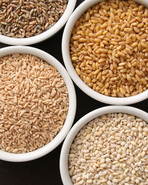
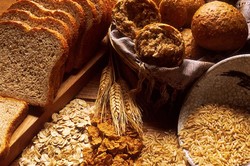
Whole grains. While all whole grains are loaded with manganese, uncooked grains have even more manganese than cooked grains. A cup of dry, uncooked rice bran or wheat germ has a whopping 16.8 and 15.3 mg of manganese respectively. That means that if you sprinkle a couple of tablespoons over your cereal in the morning you will have easily met your day’s need for manganese. And that’s not to mention all the manganese in your presumably whole-grain cereal.

A cup of most cooked whole grains will get you close to or over your daily manganese requirement, including brown rice, quinoa, bulgur, amaranth, and spelt.

Some grains that you might enjoy without cooking include rolled oats, germ, and bran. Try soaking kasha (buckwheat), oats, or millet overnight and enjoy them cold the next morning.

The Standard American Diet tends to be much higher in refined grains than whole grains, and a significant amount of manganese gets removed from refined grains. So be sure to eat whole grains!
​

Picture

​Nuts.
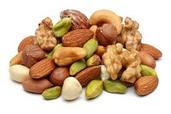
Hazelnuts and pine nuts are at the top of this list: just one ounce gives you well over your daily requirement for manganese with 3.6 and 2.5 mg respectively. And one ounce of macadamia nuts, walnuts, and pecans gives you at least half your daily requirement. Other excellent sources of manganese include almonds, cashews, peanuts, Brazil nuts, pistachios, and coconut meat.

Picture
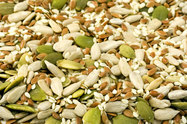
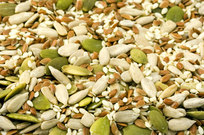
Seeds. Hemp seeds top this list with 12 mg manganese per cup. Three tablespoons in a smoothie gives you an entire day’s worth of manganese with 2.3 mg. Other excellent sources include pumpkin and squash seeds, chia seeds, flax seeds, sesame seeds, and sunflower seeds.
​

Picture
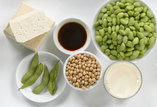
​Soy. In addition to other healthful benefits, soy is also a great source of manganese. A single cup of roasted soybeans, firm tofu, or tempeh gives you an entire day’s worth of manganese with 3.7, 3.0, and 2.2 mg respectively. Other great sources include edamame, sprouted soybeans, and soymilk.
​

Picture
​Veggies. Manganese another good reason to eat your veggies. A one-cup serving of green beans and lima beans deliver an entire day’s serving of manganese with 2.2 and 2.1 mg respectively, and one cup of several veggies deliver a quarter or more of your daily manganese needs, including sweet potatoes, yams, potatoes, peas, squash, and beets.
​

Picture
​Beans and legumes. All beans and legumes are great sources of manganese, and a cup of several beans deliver over half your daily manganese requirement, including chickpeas (1.7 mg), small red beans (1.3 mg), white beans (1.1 mg), and baby lima beans (1.1 mg). Other excellent sources of manganese include lentils, lima beans, navy beans, great northern beans, small white beans, black-eyed peas, yellow beans, split peas, pinto beans, black beans, and kidney beans.
​

Picture
Fruit. Pineapple, blackberries, and raspberries top out this category with 1.5, 0.9, and 0.8 mg of manganese per cup respectively. Many other fruits such as grapes, bananas, strawberries, blueberries, persimmons, and apples, and including avocados, tomatoes, and peppers, deliver at least 10% of your daily manganese requirement, making them good sources according to FDA guidelines.
​

Picture
​Greens and cruciferous veggies. Spinach tops this list with 1.7 mg manganese per cup of cooked spinach. Cooked garden cress (0.5 mg), kale (0.5 mg), Swiss chard (0.6 mg), beet greens (0.7 mg), and collards (1.0 mg) weigh in at over a quarter of your daily manganese requirement per cup. Other good sources include cooked and raw turnip greens, Moringa leaves, Brussels sprouts, garden cress, spinach, turnip greens, bok choy, dandelion greens, collards, Moringa leaves, cabbage, and broccoli.
​

Picture
Chocolate. One ounce of unsweetened baking chocolate or unsweetened cocoa powder gives you half your daily requirement for manganese at 1.2 and 1.1 mg respectively. Now you have another reason to eat chocolate!
​

Picture
And yes, mangoes do have manganese. In fact, there happens to be 0.1 mg of manganese in a cup of mangoes. 

Picture
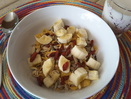
Try this for a delicious and satisfying, manganese-rich breakfast: start with about half cup of uncooked rolled oats and add another half cup of unsweetened, whole-grain cereal flakes such as corn flakes. Sprinkle a teaspoon each of chia seeds, sunflower seeds, pumpkin seeds, and slivered almonds over the top. Then add a sliced banana and about a quarter cup of mixed berries. Pour vanilla soymilk over the top and enjoy!
​

 
Resources
http://umm.edu/health/medical/altmed/supplement/manganese
https://www.organicfacts.net/health-benefits/minerals/health-benefits-of-manganese.html
https://www.healthaliciousness.com/articles/foods-high-in-manganese.php
​​

0 Comments

How to Pick the Perfect Cantaloupe Every Time

9/13/2016

2 Comments

 
Picture
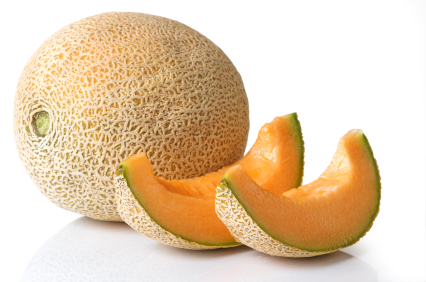
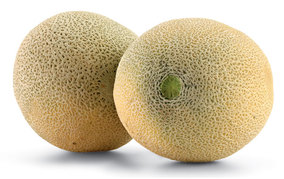
​Cantaloupes are at the very top of my “favorite fruits” list. At their best, they are intensely sweet and refreshing, not too hard, not too soft or mushy. I love eating them chilled, and can eat almost an entire cantaloupe in a single sitting.
 
My Grandmother always kept fresh cantaloupe cut up in her fridge, and each piece I ate was as sweet and flavorful as the last and the next. Perfection in each and every bite, time after time, year after year!
 
I tried to achieve that perfection myself by buying cantaloupes that were cut in half so that I could see the flesh, because otherwise I didn’t know how to tell if it’s ripe from the outside. I thought that the bright fleshy-orange color was the key to a good cantaloupe. But the flavor and sweetness was never consistent, and finding a good cantaloupe was always hit-or-miss. I was always disappointed when I found what looked like a perfect cantaloupe, only to bite into watery, flavorless flesh that was tasteless and not sweet at all.
 
I finally asked my Grandmother how she found the absolute very best cantaloupes each and every time. And here’s what she told me. 
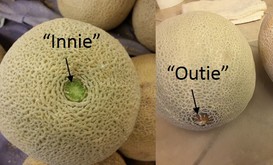
​1. Look at the stem end of the cantaloupe. That tells you how ripe the cantaloupe was when it was picked. Like belly buttons, cantaloupes have “innies” and “outies”. An “innie” shows that the cantaloupe ripened mostly on the vine and was picked at the right time. An “outie” shows that the cantaloupe was picked too early, and did not ripen on the vine. “Outies” are generally the cantaloupes that disappoint because once off the vine, they don’t ripen as well as “innies”. So only look at cantaloupes that have “innies”.
Picture
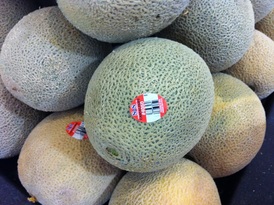
​2. Look at the color. All cantaloupes have what looks almost like a beige “netting” over the entire fruit. Look at the color under the beige. You want that color to be a pale yellowish-orange. That means it’s ripe. If it’s dark green, it’s not ripe. While a cantaloupe that has dark green color and an “innie” is not ready to eat now, it will likely ripen to a perfect cantaloupe in a few days.
Picture
​3. Smell the stem end for sweetness. A ripe cantaloupe will have a sweet, cantaloupe-smell that’s not too strong when it’s ready to eat. A strong cantaloupe-smell means that the cantaloupe is over-ripe and will likely be mushy. A cantaloupe with an “innie” and no smell is not ready to eat now, and will ripen in a few days.
Picture
4. ​Firmness. While all cantaloupes are generally firm, a ripe cantaloupe will have a little “give”, while an unripe cantaloupe will be hard.
​As long as you pick a cantaloupe with an “innie”, you should be fine. If it’s green, hard, and/or has not smell, that only means that it’s not ready to eat yet. And if you wait a few days or so until it softens slightly, has a yellowish-orange color, and a sweet smell at the stem end, you will enjoy cantaloupe perfection. 
2 Comments

What Good is Having Wealth if You Don’t Have Your Health to Enjoy It?

9/7/2016

0 Comments

 
Picture
​Is there anyone out there who hasn’t at least thought about being wealthy? Wealth to me is always having more money than I could or would spend. So by my definition, having as little as $1.00, or even $0.01 over that amount makes me wealthy. To someone else wealth could be having some number in the bank or in assets, such as $1 million, $10 million, or more.
 
It’s fun to think about what I would do if I were wealthy. I like to picture the things I would do and places I would go if I were wealthy. I would travel to far-away places with mountains, beaches, and rivers. I always picture myself being active and doing things. Walking. Biking. Skiing. Riding horse-back. Always in some kind of beautiful and exotic scenery.
 
I’m not that materialistic, so I don’t really think about having lots of things. Although one exception is to have a large, beautiful, and functional kitchen. I spend a lot of time in my kitchen cooking for my family and leading cooking classes because I love doing those things. So there would definitely have to be a nice kitchen.
 
I’ve asked others what they would do if they were wealthy, and they have all told me of things they would like to do and places they would like to go. Do and go. I think that the unspoken given for everyone is to be in excellent health and completely pain-free. Nobody has ever said to me that they envision having a chronic degenerative condition and/or have difficulty moving around, or worse, be unable to move around.
 
Which gets me to my next point: what good is having wealth if you don’t have your health to enjoy it? You need to be healthy to do the things you want to do and go to the places you want to go. In other words, you need to be healthy and feel good to be active.
 
I know several people who are not just envisioning wealth, they are wealthy. Some of those I know are obese and/or have some chronic degenerative condition along with having difficulty getting around. Mind you, none of the wealthy people I know were born into wealth. And I’m sure that when they imagined being wealthy, they didn’t imagine being in the conditions they are today.
 
Sure, if you’re going to be in poor health, being wealthy is probably better since it allows you the best possible treatment and care. But what does that mean? More pills? More procedures? Better walkers? Better beds? Bigger TV screens? Perhaps convalescing in a resort or spa while they’re turning you to prevent bed sores and helping you to the bathroom? So you’re sedated and oblivious. But I doubt that’s what you envisioned.
 
Many people just assume that they will end up with a chronic degenerative disease, and that it’s just a matter of time. And that is very likely to happen on a western diet that’s loaded with fat, sugar, salt, and highly processed foods.
 
The great news is that it doesn’t have to turn out that way. We have much more control over our health destiny than most of us realize. It comes down to the food choices we make with every bite.
 
A whole food plant-based diet has proven over and over again to prevent, stop, and even reverse chronic degenerative diseases by eliminating significant risk factors such as high cholesterol, high blood pressure, high blood sugar, and obesity. A whole food plant-based diet prevents and reverses diabetes, heart disease, and erectile dysfunction (this is documented all over the scientific and medical literature). Additionally, a whole food plant-based diet prevents strokes and most cancers, and significantly lowers the risk of getting Alzheimer’s disease and other cognitive impairments as well as autoimmune diseases, neuropathies, and visual impairment.
 
And I’m talking about just with whole, unprocessed foods from any common grocery store. No special medications. No special supplements. Just plain, old groceries. Apples. Bananas. Berries. Melons. Tomatoes. Avocados. Lettuce. Spinach. Kale. Carrots. Cucumbers. Peppers. Potatoes. Squash. Brown rice. Quinoa. Whole grain pasta. Beans (not the kind with pork). Almonds. Walnuts. Sunflower seeds. Pumpkin seeds. Flax seeds. You get the idea.
 
By adopting a whole food plant-based lifestyle, you can have excellent health, along with more energy than you can imagine, which allows you to continue to do all the things you love to do. Now, isn’t that wealth?
Picture
0 Comments

Has This Ever Happened to You?

8/30/2016

0 Comments

 
Picture
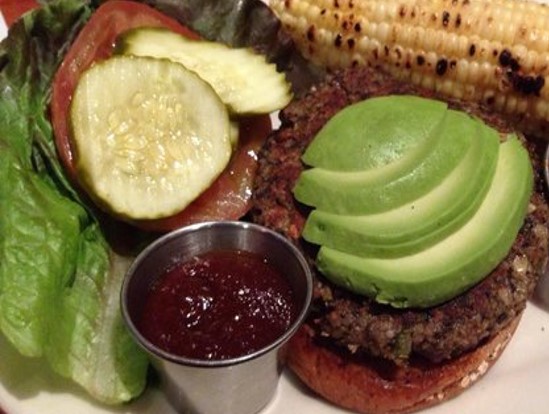
​I was visiting some good friends who live a few hours away from me, and we went out to have dinner at a restaurant we love to go to when we get together in their area. I was really looking forward to the house-made vegan bean burger! They season it well and use peanut butter as a binder, and it’s delicious! And it’s served with fresh greens, sliced tomato, and half an avocado on a whole wheat bun. Yum! I haven’t had one in ages and I was set on having one last night!
 
The server came to take our order. I was confident that this was a simple, slam dunk order in terms of getting something vegan in a non-vegan restaurant. But just to double check, I asked the server if there’s any dairy at all in the bean burger, and she told me that they put mayonnaise in the patty. Mayonnaise?!?! What?!?!
 
Ok, so now I’m ordering the quinoa salad instead, which was probably an even better choice, but that’s what I always get. I really wanted that bean burger! So I asked her again, “Are you sure the bean burger is not vegan? I’ve had it before and was told that it’s vegan?”. So she asked another server, who told her that yes, the bean burger is vegan and no, they don’t use mayonnaise. Yay!!! I’m getting the bean burger!
 
My next question: do they put anything on the bun? Yes, they grill it with a little butter. So I ask that the bun is served dry, no butter, nothing on it at all, just a plain bun.
 
And it’s even worth it to me to pay the extra $1.50 to get a side of sweet potato fries. I asked if they sprinkle any cheese over the sweet potato fries and the server told me that no, they don’t. And in fact, that she would make sure they didn’t use any seasoning on the sweet potato fries. Perfect!
 
So to recap, I ordered a vegan bean burger, bun dry, and sweet potato fries with no seasoning. Simple, right?
 
After a short wait, the burger and sweet potato fries came out. Yay! It looks soooo good! But wait, there’s a little cup on the side of plate against the burger and the sweet potato fries with a creamy pink dressing in it. Is that Thousand Island dressing??? What is THAT doing on my plate??? Didn’t I say “vegan” (more than once, in fact)??? Well, ok, they must have been really busy. I can just take it off my plate, no problem, right?
 
Except that in transit the creamy pink dressing spilled onto the plate and soaked into the bottom half of the bun as well as all the sweet potato fries on that side of the plate. And as if that wasn’t enough, I turned over the top half of the bun, and sure enough, it was grilled with butter. Then I tasted an “uncontaminated” sweet potato fry, and it was doused in a super-salty seasoning. So much for no seasoning on the sweet potato fries.
 
I’m sorry, but I couldn’t eat it. I explained the problem to the server and ended up sending it back. I tried to be as clear as possible in the first place (and was really nice about it) to prevent this from happening. So besides my dinner being ruined because it wasn’t prepared as specifically requested, the server was clearly annoyed with me for pointing it out (I was still smiling politely).
 
I wish I could say that this was an isolated incident. But it’s not. In fact, what is an isolated incident is when I order something with no meat, dairy, or eggs, and it actually comes out that way from the kitchen.
 
I’ve been plant-based for nearly five years now, and in those five years I’ve seen a huge shift in demand for vegan/plant-based foods in mainstream restaurants. More and more people are vegan, so these kinds of requests should be getting more familiar to restaurant staff. Especially given that so many restaurants now have vegan or vegan-friendly options on their menus.
 
I think the problem in restaurants could be that restaurant staff who are not vegan themselves do not really understand what vegan means. It’s not only the visible meat, cheese, cream, or eggs on food that counts. Animal foods such as eggs, cheese, and milk are often cooked into parts of the meal such as bread or pasta, and are not visible. The problem could also be that while the server writes down any special requests, the kitchen staff may completely ignore what’s written on the ticket.
 
Either way, it’s frustrating for the patron, the server, and the cooks. And on top of that, the restaurant loses money when food that can’t be consumed by the patron gets sent back and has to be re-made.
 
So if your goal is to order vegan, and you don’t want to go through all this, there is something else you can do (besides staying home). Order a dish that comes with no meat (so you eliminate any special no-meat requests). Then tell the server that you are allergic to dairy and eggs. Because of the potential liability to the restaurant when a food allergy is involved, the server is suddenly able to point out any dairy or eggs that might be lurking in that dish, and also offer alternatives. Now is anything goes wrong, it’s on them, and they don’t take it out on you.
 
Isn’t it funny how differently you are treated with the exact same request depending on whether your request is due to a medical condition or a personal choice. I know that telling a server that I have a dairy and egg allergy is not the truth, and for that reason, I don’t like to do it very often. But in hindsight, that’s what I should’ve done last night. It would have made it easier and more enjoyable for everyone.
 
And yes, I still left the server a decent tip.
 
If you have a story, leave it in the comments. How did you handle it?
0 Comments

How to Stay Off Medications

8/22/2016

0 Comments

 
Picture
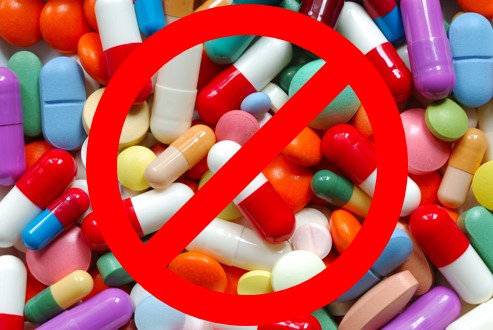
If you’ve seen any of my posts on my website, Twitter, or other social media, it’s probably kind of obvious that I have a passion for plant-based nutrition. I’ve been plant-based for over 4 ½ years now and I made that lifestyle choice to enhance my health. Working as a scientist on drug-design teams made me clear on one thing: I don’t ever want to have to be on any kind of medication. Although I was already on one medication and had been for years – albuterol inhalers for my asthma, which I had been using several times a day for most of my life.
 
Getting diagnosed with a condition and having to start taking medications always seemed so random to me. Like it could happen to anyone at any time, regardless of lifestyle. While I always believed that regular exercise and a healthy diet helps, I also believed that getting diabetes, heart disease, or cancer has more to do with genetics and how lucky or unlucky you are. We’ve all heard of someone that is what we think of as the picture of health who suddenly drops dead of a heart attack.
 
My grandmother ate what most would consider a healthy diet and swam several times a week from when she was a child until she was 92 years old. She never had to take a single medication, until she had a “mild” heart attack at the age of 88. After that she was suddenly on a whole host of medications for her blood pressure, cholesterol, blood viscosity, and electrolytes, and she was kept on all those medications for the rest of her life.
 
So I thought that all I could do was exercise, eat “healthy”, and hope that I would be lucky enough to never get diagnosed with any kind of disease. Beyond that, I had absolutely no idea how I could prevent myself from getting sick and having to take any other medications.
 
Until I read “The China Study” by T. Colin Campbell, PhD. He presented very compelling evidence that animal-based foods make us sick and whole plant-based foods protect us from diseases and keep us healthy.
 
And here’s why I believed him: T. Colin Campbell has published over 300 peer-reviewed scientific journal articles on his own findings on the link between animal protein and cancer, essentially that animal protein is an on/off switch for cancer, yet there is no correlation between plant protein and cancer. He also received 27 consecutive years of grant funding from the National Institutes of Health, a highly competitive task among top researchers.
 
Why is that important to me? I’ve written and reviewed both peer-reviewed scientific journal articles and grant proposals, so given my background, I knew of the rigorous scrutiny his work underwent in order to get published and funded, and that spoke to me of the scientific integrity of his work. And while that process may not be perfect, it is the best system we have for maintaining scientific integrity.
 
I was a meat- and dairy-eater through and through for my entire life. Yogurt and/or eggs with cheese for breakfast; a deli-meat or tuna sandwich smothered in mayonnaise and cheese for lunch; cheese for snacks, and a steak, cheeseburger, chicken breast, meat & cheese burrito, or piece of fish for dinner, always with a side salad and veggie. I thought I was eating healthy and had no intention of ever giving up any of those foods.
 
Then something very strange happened. While I was reading “The China Study”, I began to make foods that I knew I liked that didn’t have any meat. For example, fusilli pasta with broccoli, garlic, and parmesan cheese, only I left off the cheese. Or a bean and rice burrito with veggies, and again, I left off the cheese. Or a marinara sauce with mushrooms, eggplant, onions, garlic, and lentils over whole-grain pasta, no cheese. Or a marinara sauce with roasted butternut squash over whole grain pasta or rice, again, no cheese.
 
What was so strange about that? The fact that I didn’t fully realize what I was doing until I got to the end of the book and came to the challenge to go 28 days completely plant-based to see how I would feel. I thought “Ha! I could never do that! I eat meat and dairy all the time. That is never going to happen!”.
 
When I started to think about how much meat I eat, it made me think back to the last time I ate any meat, which I thought was maybe a day or two prior. I was shocked when I realized that I hadn’t eaten any meat or dairy for two whole weeks! And I felt FANTASTIC!!! Maybe that explained why I had so much more energy, felt lighter, saw my skin begin to firm up, slept better, and felt some looseness in my clothes.
 
I decided to keep this experiment going, but my only commitment was a meal at a time. I made a game out of coming up with something to eat for my next meal that had no meat, dairy, or eggs in it, and had fun with it. It was only an experiment, so I could just keep doing it until I got bored or wanted something animal-based that I couldn’t resist. For me, that was an In-N-Out Double Double Cheeseburger.
 
The funny thing is, I never got bored with the plant-based foods I was eating, and while the idea of that In-N-Out Double Double Cheeseburger always sounded good to me, anytime I decided to go get one, it stopped sounding good by the time I arrived at the In-N-Out restaurant, so I never stopped to get one. I always ended up eating something at home instead. I did eat some grilled salmon once about three months later. It didn’t taste that great and I didn’t feel that great after eating it.
 
The trade-off from giving up animal-based foods was so worth it to me. I continued to lose weight and feel better and better! I finally lost those last 10 pounds that never seem to want to budge, and I lost fat from places where I was never able to lose fat before such as my hips. 
Picture
​And best of all, my asthma completely cleared up about 8 months later!!! I used to keep albuterol inhalers everywhere – in at least four rooms inside my house, in my purse, and in my car – so that I would never be without one. And I inhaled two puffs every two hours throughout every day. Today I don’t even know where or if I even have an inhaler!
 
So now I know how to prevent myself from ever having to take medications, and it’s very likely that I will never need any of the medications I used to help design (or any others). I love this lifestyle so much and find it so easy that I have no doubt that I truly am keeping myself as healthy as possible.
 
You can too! It’s not as hard as you think. Try it for 28 days – what have you got to lose? 
0 Comments

What is Selenium & Where Can I Find It?

8/15/2016

0 Comments

 
Picture
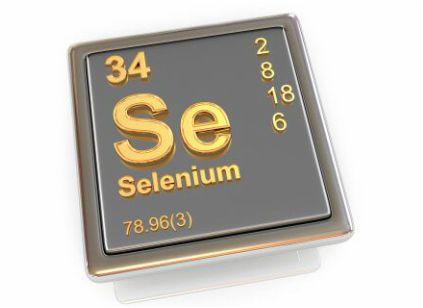
​Selenium is an important micronutrient that our bodies need in very trace amounts. The recommended amount for adults is 45 micrograms (µg) per day*, which is only 45 millionths of a gram!
 
Selenium is essential for forming enzymes with antioxidant properties that protect against oxidative stress and other free radicals that can lead to heart disease and cancer. Selenium also helps protect our immune system and keep our thyroid functioning normally.
 
The best way to get selenium is through our diet, in the foods we eat. Excess selenium through supplements is not recommended because it can be harmful and even result in death.
 
Here are some great plant-based sources of selenium that provide you with at least 10% of the daily recommended amount:
Picture
Whole grains
Whole grains, which are some of my absolute favorite foods, are an excellent source of selenium. A half cup of wheat germ has just over 45 µg of selenium, an entire day’s worth! And one cup of cooked Khorasan wheat, an ancient variety of wheat, has almost 55 µg of selenium while a cup of sprouted wheat and wheat bran each meet the 45 µg daily requirement.
 
Even whole grain pasta, including a cup of cooked whole wheat pasta (100% whole wheat) and 51% whole wheat pasta will give you most of your daily requirement with 43 and 40 µg of selenium respectively. And a sandwich on two slices of whole wheat bread has half the daily selenium requirement from the bread alone.
 
Are you avoiding wheat because you’re glucose intolerant? These naturally glucose-free cooked grains are also good sources of selenium, including amaranth (14 µg), and brown rice (12 µg) per cup. Uncooked oat bran (43 µg/cup) and rolled oats (23 µg/cup) make a great addition to cereal. A little lower, and still a good glucose-free whole grain source is cooked quinoa. And if you’re not glucose intolerant, don’t forget about pearled barley (14 µg/cup), one of my favorite grains!

Picture
Seeds
Seeds are another great plant-based source of selenium. Only half a cup of sunflower seeds gives you your daily requirement for selenium! Sesame seeds and pumpkin seeds are also good sources of selenium. Enjoy seeds as a snack or sprinkled over salads, bowls, soup, in stir fries, and over pasta for a nice crunch. And next time you get sesame seeds on your bread or bun, remember, you’re getting selenium!


Picture
Nuts
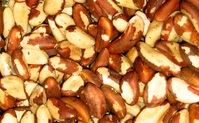
Brazil nuts top the charts for selenium with a whopping 319 µg of selenium in only an ounce. That’s over seven times the daily requirement for selenium in only an ounce of Brazil nuts!
 
While walnuts, cashews, macadamia nuts, peanuts (which are actually legumes), and pistachio nuts may have significantly less selenium than Brazilnuts, these nuts will help move you toward your daily selenium goal. Like seeds, you can enjoy these nuts as a snack or sprinkled over salads, bowls, soup, in stir fries, and over pasta.

Picture
​Soy
Cooked soybeans, along with tofu, which are made from soybeans, are also good sources of selenium. Dried soybeans when cooked can range from 13 µg of selenium (boiled) up to 33 µg of selenium (roasted) per cup. On the other hand, green soybeans (edamame) are not the best source of selenium with less than 3 µg of selenium per cup when cooked. Roasted soybeans make a great snack!
 
Tofu is very versatile and can be used in soups, stir fries, scrambles, sauces, dips, desserts, and even marinated and baked. Tofu is also an excellent source of selenium. A half cup of raw firm tofu prepared with calcium sulfate, commonly found in most grocery stores, has 22 µg of selenium. If you fry that same tofu, the selenium content jumps to 36 µg of selenium per half cup!

Picture
Nondairy Milk
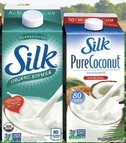
Prefer to drink your selenium? Coconut milk and soy milk are also good sources of selenium. Raw coconut milk has 15 µg of selenium per cup while soy milk has nearly 12 µg of selenium per cup. Both coconut milk and soy milk are great alternatives to cow’s milk. Both come in sweetened or unsweetened and plain or vanilla varieties. I prefer plain, unsweetened for cooking. You might like the sweetened and/or vanilla varieties to enjoy over cereal or for a simple and delicious version of berries and “cream”.


Picture
Molasses
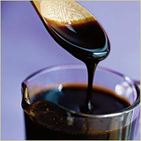
Molasses, less sweet than sugar, is a good substitute in baking for brown sugar, honey, and even maple syrup, and is also a good source of selenium as well as other nutrients. Molasses contributes to the distinct flavors of gingerbread and baked beans. Try adding molasses to sauces and marinades to add some sweetness and a rich and distinct flavor or using molasses as a glaze for roasting sweet potatoes and butternut squash. Drizzle a little molasses over oatmeal for a lightly-sweetened breakfast treat.

Picture
Mushrooms 
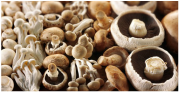
Mushrooms add amazing flavor and texture to many foods, and can turn ordinary meals into savory treats. And mushrooms are another good source of selenium. Shiitake mushrooms are great in stir fries, and a cup of cooked shiitake mushrooms has 36 µg of selenium. Grilled portabella mushrooms are robust and have a very meaty taste and texture. Next time you are enjoying a portabella mushroom burger think about the 27 µg of selenium in that burger. Even a cup of cooked ordinary white mushrooms has 19 µg of selenium. Try roasting or sautéing mushrooms and smothering a baked sweet potato or a veggie burger.

Picture
Yellow & green beans, raw
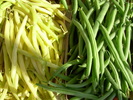
Green beans, also called string beans, and yellow beans are excellent sources of selenium when eaten raw with 25 and 24 µg of selenium respectively per cup. Both green and yellow beans lose much of their selenium content when cooked, leaving only about 10% of the original amount behind. For a great snack, try dipping some raw green and/or yellow beans into hummus or a bean dip.

​

*Dietary Reference Intakes (DRIs): Estimated Average Requirements, Food and Nutrition Board, Institute of Medicine, National Academies.

​Resources:
http://www.ncbi.nlm.nih.gov/pmc/articles/PMC2698273/
Selenium values from the USDA nutrient database
http://www.organicauthority.com/health/how-and-why-to-use-molasses.html
​​

0 Comments

Eleven Foods with More Potassium than a Banana

8/8/2016

0 Comments

 
Picture

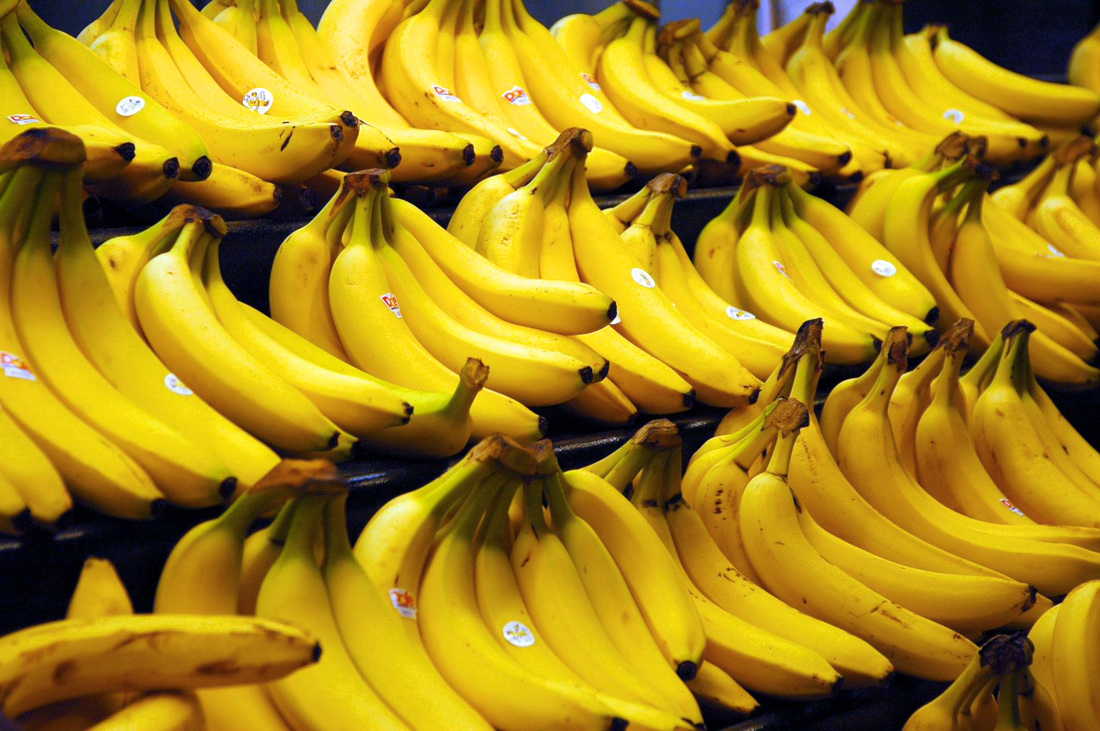
The first thing most people think of eating when they need more potassium is a banana. According to the USDA Nutrient Database, single, medium-size banana, about 7 inches long has 422 milligrams (mg) of potassium. Now, I love bananas, and in order to get our recommended daily 4,700 mg of potassium* from bananas only, we would have to consume over 10 bananas every day. That’s a lot of bananas!
 
Before grabbing all those bananas, here are 11 other whole plant-based foods with even more potassium than a banana:
 
1. Potatoes
Baked potatoes (with skin) top this list with over 1,600 mg of potassium in each large (3-4 ¼” diameter) potato! For example, a large russet potato has 1,644 mg, a large red potato has 1,630 mg, and a large white potato has 1,627 mg of potassium!
 
2. Yams and Acorn Squash
Yams and acorn squash are also high on this list. One cup of yam flesh, cut into cubes packs 911 mg of potassium, more than twice the potassium in a single medium-size banana. And coming in a close second, one cup of acorn squash cut into cubes has 896 mg of potassium!
 
3. Sweet potatoes
A medium baked sweet potato that’s about 2” in diameter and 5” in length has 542 mg of potassium. These are great with a meal and also make a delicious and handy snack. Simply prick the skin several times and place them in the oven at 400 °F for 45 minutes, or until tender when pricked with a fork.
 
4. Soybeans
A half cup of shelled, boiled edamame, one of my favorite snacks, has 443 mg of potassium. I find it easy to have more than a half cup of this quick, easy, and nutritious treat! A cup of firm tofu that’s prepared with calcium sulfate, the common source of calcium in tofu, has 598 mg of potassium and a cup of tempeh, or fermented soy beans, has 684 mg of potassium. Try making a quick and simple miso soup by adding about ¼ cup of miso, a package of firm tofu, drained and cut into ½” cubes, and ¼ - ½ cup of dried seaweed into about 6 cups of boiling water. Simmer for 1-2 minutes and serve.
 
5. Sun-Dried Tomatoes
A half cup of sun-dried tomatoes has 463 mg of potassium. Sun-dried tomatoes are delicious and can be added to foods such as soups, salads, sauces, and sandwiches, either as is (dried) or reconstituted by soaking in water. Avoid sun-dried tomatoes packed in oil to protect your arteries.
 
6. Raisins
This tasty snack has 618 mg of potassium in a half cup of seedless raisins. Not only do raisins make a great snack, they are a great addition to salads, soups, cereal (hot and cold), and baked goods.
 
7. Unsweetened Cocoa Powder
I’ll bet you never thought about unsweetened cocoa powder having lots of potassium. In fact, half a cup of unsweetened cocoa powder has 656 mg of potassium. Not that you will consume half a cup in one sitting, you can sprinkle a tablespoon of unsweetened cocoa powder over your banana and add another 82 mg of potassium to your banana.
 
8. Greens
Cooked beat greens and Swiss chard come in at the top of the greens. A cup of cooked beet greens has 1,309 mg and the same amount of Swiss chard has 961 mg of potassium. These greens are delicious in salads, in soups, blended in sauces, or just sprinkled with a nice balsamic vinegar.
 
9. Beans
While beans are a great source of potassium in general, a half cup of some beans have even more potassium than a medium banana, and a full cup of pretty much all beans come in at over 422 mg of potassium. Red beans, white beans, and lima beans weigh in at 612, 502, and 485 mg per half cup respectively. And black beans, pinto beans, kidney beans, and navy beans, for example, come in at 801, 746, 717, and 708 mg of potassium per cup. Beans are great with a whole grain such as brown rice in a burrito or a bowl, and make a great, hearty addition to soups and salads.
 
10. Avocados
A single avocado has 690 mg of potassium. Try making guacamole by adding fresh roasted chiles, onions, and garlic, adding avocado slices to toast or a sandwich, or adding avocado cubes to a salad.
 
11. Seeds
Sunflower, pumpkin, and squash seeds are a great source of potassium. Each half cup of dry roasted sunflower seeds has 544 mg of potassium while each half cup of dried pumpkin & squash seeds has 522 mg of potassium. Seeds are great sprinkled over cereal, over salads, or to add crunch to other dishes, and also make a great snack.
 
 
*Dietary Reference Intakes (DRIs): Estimated Average Requirements, Food and Nutrition Board, Institute of Medicine, National Academies.

Potassium values from the USDA nutrient database.

0 Comments

What Are We Calling Protein and Can Vegans Possibly Get Enough?

6/10/2016

2 Comments

 
Picture
Why do we need to worry about getting enough protein? That’s because our bodies use proteins in many ways, including to build and repair tissue such as muscle, bones, cartilage, hair, and nails, to make enzymes and hormones, to produce antibodies for our immune system, to transport nutrients in and out of our cells, and to transport oxygen in our blood. We have proteins in every cell in our bodies.

When we think of protein, we mainly think of meat, poultry, fish, dairy, and eggs, all animal-based foods. So much so that we even define these foods as “proteins”.
 
However, we don’t typically think of plants when we think of protein.
 
Many of us believe that eliminating meat, poultry, fish, dairy, and eggs means eliminating protein. That’s why it’s hard for many of us to believe that it’s at all possible for vegans to get enough protein.
 
But these animal-based foods are not actually proteins at all. Rather, they are sources of protein, or more specifically, protein molecules. In fact, only about 19-23% of the mass of lean muscle flesh (meat) consists of protein molecules. The rest is water, fat, carbohydrates (yes, animal-based foods have carbohydrates), cholesterol, and other micro-nutrients (these are all molecules too). Fatty meats have even less protein because they have more fat and less protein-rich muscle flesh.
 
Plants have protein molecules too. Plants need protein for structure, photosynthesis, and to make enzymes and hormones for growth and development. And like us, plants also have proteins in every cell.
 
All protein molecules, whether from animals or plants, are made of amino acids that are strung together like beads on a necklace. The only differences from protein to protein are which amino acids are in the protein, how many of each amino acid, and the particular sequence in which the amino acids are strung together.
 
Our bodies can produce 11 of the 20 amino acids that we need to build protein molecules. Essential amino acids are those 9 amino acids that our bodies need and cannot produce, and therefore must come from food sources. Protein molecules that we get from foods are broken down into amino acids that our bodies then use to build the proteins we need.
 
Plants, on the other hand, have to produce all 20 amino acids from nutrients in the soil in order to make protein molecules because they don’t get amino acids by consuming animals or other plants. As “amino acid factories”, plants have it all, including an ongoing supply of all 20 amino acids so they can produce the proteins they need for growth and development.
 
We need essential amino acids from our diet. Plants make all 20 amino acids, including the 9 essential amino acids. That makes plants a great dietary source of protein!
 
Anyone that consumes a whole food plant-based diet gets their protein the same way that a carnivore’s protein gets its protein. Cows get their protein from plants (namely grass), which as we now know, have all the protein they need! Otherwise cows and other herbivores (plant eaters) such as elephants, giraffes, horses, and gorillas could not grow to their impressive sizes.
 
How much protein do we need? At a minimum, we need to replace the amount of protein that our bodies eliminate every day, which is about 0.5-0.6 grams (g) of protein per kilogram (kg) of body weight per day. This amount is known as the Estimated Average Requirement (EAR).

The Recommended Dietary Allowance (RDA) increases the EAR to 0.8 g of protein per kg of body weight per day, which adds a margin that insures that at least 98% of the population gets enough protein. In other words, the RDA, 0.8 g of protein per kg of body weight per day is more protein than most of us actually need. If you’re consuming that amount of protein, you are getting plenty of protein and do not need any more than that!

In terms of calories, 0.8 g of protein per kg body weight per day (or 0.36 g of protein per pound body weight per day for those of us in the US) is equivalent to about 8-10% of our total dietary calories. This amount is readily provided by all plants! 

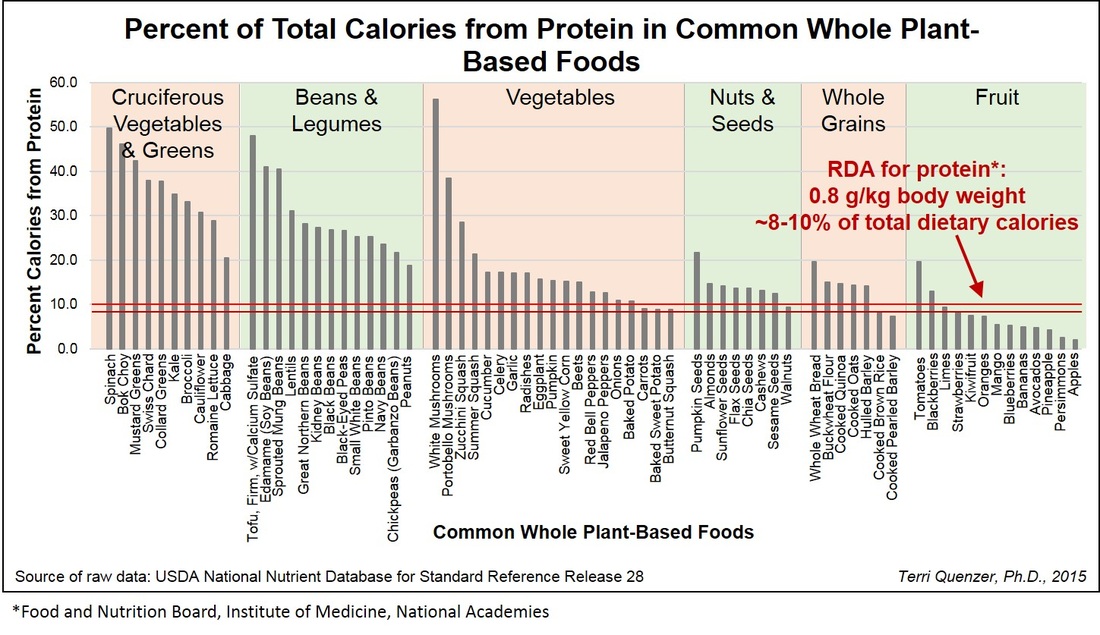
To confirm this, I went to the USDA National Nutrient Database and looked up the calories and protein (provided in grams) for several plant-based foods, including vegetables, fruits, whole grains, beans, lentils, nuts, and seeds. I converted grams of protein into calories from protein (1 gram of protein = 4 calories), and used that to calculate the percent of protein that’s in each plant-based food that I looked up. I charted those values, along with the RDA for comparison, and here’s what I found:
Picture
All plant-based foods on this list, with the exception of some of the fruit, either meet or exceed the RDA of 8-10% calories from protein.
I’ll bet you’re surprised to see that many vegetables, especially leafy greens and cruciferous vegetables, have more calories from protein than beans, nuts, and seeds! And white mushrooms weigh in at 56% of their calories from protein!

Kaiser Permanente recommends the following guidelines for daily servings of whole plant-based foods:
  • 6 or more daily servings of vegetables, including at least 1 daily serving of leafy green vegetables
  • 2-4 daily servings of starchy vegetables such as potatoes and winter squash
  • 2-4 daily servings of fruit
  • 2-5 daily servings of beans and legumes
  • 5-8 daily servings of whole grains
  • 1-4 daily servings of nuts and seeds   

​Anyone that consumes that many servings of all those whole plant-based foods is definitely getting plenty of protein, even with a few servings of fruit thrown in.
 
The only danger of not getting enough protein is by eliminating all protein sources, including whole plant-based foods. This is something to be aware of if you or someone you know is vegan and eats mainly processed and refined foods with little or no whole plant-based foods such as vegetables, beans, whole grains, nuts, and/or seeds. Another term for that is a “junk food vegan”. This is typically the case if you know of someone who is/was vegan and became weak and sick.
 
Remember, meat, poultry, fish, dairy, and eggs are not proteins. They are sources of protein.

​Plants are sources of protein too. And plants have the variety and abundance of protein that our bodies need to thrive, including all 9 essential amino acids. 
2 Comments

Looking for Something Healthy That's Fast, Easy, Tasty, Convenient, and Vegan?

11/10/2015

1 Comment

 
Picture
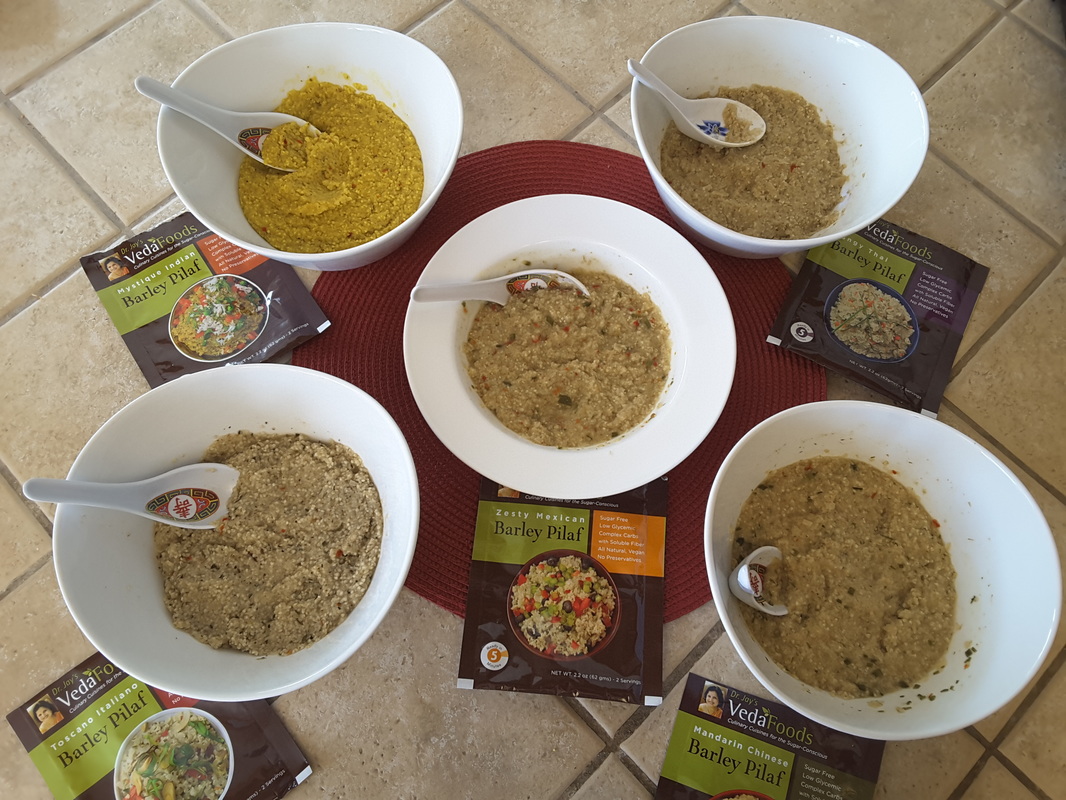
I was approached by VedaFoods to try all of the five varieties of their Barley Pilaf meals and post a review. According to VedaFoods, these meals are all natural, vegan-friendly, low-glycemic, sugar-free, have complex carbs, soluble fiber, and take only 5 minutes to make in one pot. So I put it to the test!

Starting with the Ingredients list on the back of the pouch, the first two ingredients in each of the five varieties are barley and jungle rice. The remaining ingredients are a variety of different seasonings and spices that give each variety its unique flavor. There is no added sugar, validating the “sugar-free” claim. Instead they are all sweetened with honey powder. Each has added salt. No animal-based products are listed among the ingredients, validating the “vegan-friendly” claim. None of the ingredients are synthetic, validating the “all natural” claim.

Barley and jungle rice (also called samo rice) are both complex carbohydrates and have health benefits. Barley, a chewy cooked whole grain, is a great source of soluble fiber and several other nutrients that keep you regular and help lower your cholesterol, risk of heart disease, and risk of type 2 diabetes. Jungle rice, used in India as a rice substitute, is actually the seed of a grass that is easier to digest and lower on the glycemic index than white rice, making it a better choice than white rice for preventing and managing diabetes. This validates the “low-glycemic”, “complex carbs”, and “soluble fiber” claims.

All five varieties are packaged in a pouch that can be stored at room temperature. They are very quick and simple to prepare, yes, in only 5 minutes, either on the stove-top or in the microwave oven. This validates the “only 5 minutes to make” claim. They are great for keeping in your desk at work for a quick lunch or snack or at home for a quick dinner.

They can be served as a side dish or easily converted into a meal all in one pot by adding any desired combination of vegetables, beans, lentils, nuts, seeds, or other preferences.

The only issue, in my opinion, is that at 260-280 milligrams (mg) of sodium per serving, about 10-12% of the recommended daily sodium intake, they all seemed too salty for me. Each pouch has two servings, and an entire pouch can easily be consumed as a single meal by one person, which doubles the sodium intake.

While all five varieties were very flavorful, my favorite varieties were Tangy Thai and Mandarin Chinese. My least favorite variety was Mystique Indian, only because I thought the flavor was not intense enough.
​
All the claims on the front of the pouch are true and overall I think these Barley Pilafs are great because they are healthy, tasty, and convenient. Adding other ingredients creates a fast, full, flavorful, and satisfying meal and reduces the saltiness.
1 Comment
<<Previous
Forward>>

    Terri Quenzer, PhD

    Terri has a passion for good health and for helping others find happiness in themselves through better health! Through her scientific and life experiences, her goal is to help you reach your healthy goals!

    ​Be The Healthy U!: nominated for San Diego's Best Nutrition/Cooking Classes of 2016!

    Picture
    Catch Terri's interview about plant-based nutrition on KCQB 1170 AM - click here.

    How Not to Die: Terri interviews New York Times Bestselling Author Michael Greger, MD. Listen below.
    Terri speaks with Jordan Hoffman of Jordan Hoffman Acupuncture about what to eat and East vs West.
    Picture

    Click Here To Sign Up For Your Free Newsletter

    RSS Feed

    Archives

    September 2017
    May 2017
    January 2017
    December 2016
    November 2016
    October 2016
    September 2016
    August 2016
    June 2016
    November 2015
    October 2015
    September 2015
    May 2015
    April 2015
    February 2015
    January 2015
    November 2014
    October 2014
    August 2014
    July 2014
    June 2014
    May 2014
    April 2014
    March 2014
    February 2014
    January 2014
    December 2013
    November 2013
    October 2013
    September 2013
    August 2013
    July 2013
    June 2013
    February 2013
    January 2013
    December 2012
    November 2012
    October 2012

    Categories

    All